Thursday | 15th January 2026
The American president’s extraordinary — and utterly exhausting — grip on the global psyche tightened further on Wednesday, as the world once again found itself suspended in a familiar state of anxious anticipation. A heavy tension settled over Washington, stretched taut across the Atlantic and drifted ominously across the Middle East. Diplomatic capitals, military command centers and living rooms alike were gripped by the same question: was fire about to rain from the skies?
At the center of it all was Donald Trump, whose every word, pause and provocation seemed calibrated to keep allies and adversaries guessing. Would he follow through on his vow that “help is on the way” after Iran’s brutal suppression of protesters, a crackdown that reportedly left thousands dead? Or was he looking for an exit ramp, seizing on vague and deeply questionable assurances from unnamed sources inside Iran that executions would cease?
“We’re going to watch and see what the process is,” Trump told reporters, offering just enough ambiguity to keep the suspense alive.
And that, more than anything, is the point. Everyone is waiting to see what Trump does next — and he revels in it. From behind the Resolute Desk in the Oval Office, he tosses out threats, half-promises, misdirection and insults with the flair of a conductor waving his baton. But rather than producing harmony, the result is a kind of orchestrated global chaos, a dissonant symphony in which no one else knows the score.
Asked how he could possibly trust pledges from an Iranian regime that had just unleashed one of the bloodiest crackdowns in its modern history — after decades of entrenched authoritarian rule — Trump delivered one of his signature cliff-hangers.
“We’re going to find out,” he said. “I’ll find out after this. You’ll find out, but we’ve been told on good authority, and I hope it’s true. Who knows, right? Who knows. Crazy world.”
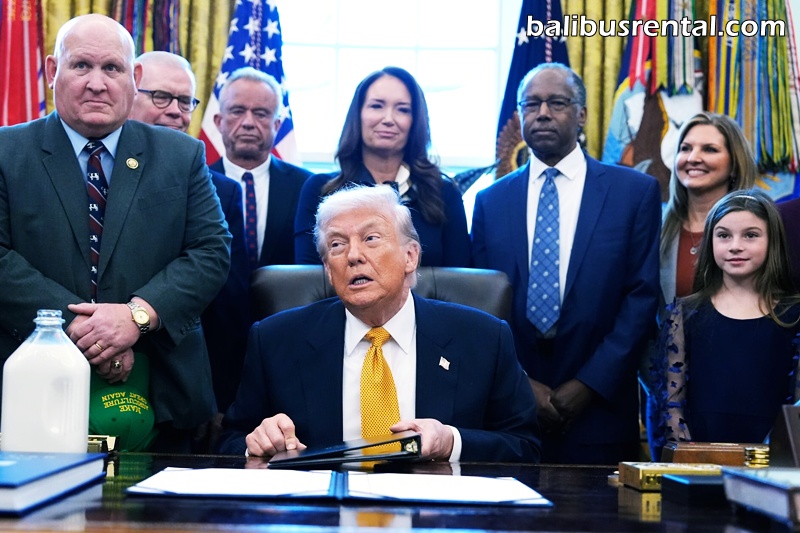
The surreal quality of the moment was impossible to miss. Trump was holding forth on questions of war and peace — decisions that could ignite a regional conflict — during an Oval Office event meant to celebrate a newly passed law allowing schools to serve full-fat milk to children.
“Remember the old days when we were kids?” Trump mused aloud, addressing a press pool desperate for clarity on whether he was about to order strikes on Iran.
Then came the digression.
“Everybody shared a bottle. Today, we tend not to do that,” he continued. “But if you’d like to, if you trust the person that you drink it after, it’s right here, it’s yours. OK?”
Gesturing to a bottle sitting on the Resolute Desk, he added helpfully: “It’s semi-fresh — five, six days old.”
The absurdity was jarring. At a moment when Iranian airspace was closing and US military assets were on heightened alert, the commander in chief was riffing about communal milk bottles. It was a snapshot of a presidency defined by whiplash.
An extraordinary turn in the Greenland saga
As so often during Trump’s tenure, the day only grew stranger.
The White House welcomed a delegation from Greenland and Denmark — not for a routine diplomatic exchange, but in response to Trump’s renewed demand to acquire ownership of the world’s largest island.
It bears emphasizing just how bizarre this encounter was. The officials had traveled to Washington to deliver a blunt message: Greenland is not for sale, and the United States should neither attempt to buy it nor contemplate taking it by force.
During Trump’s first term, his interest in Greenland was widely treated as a punchline — an eccentric aside that fizzled out amid ridicule. In his second term, however, European leaders are no longer laughing. An untethered commander in chief, openly disdainful of traditional alliances and institutions, is being taken deadly seriously.
The standoff is stranger still because Greenland is NATO territory. Trump’s claims that Denmark cannot defend it defy basic logic. Denmark is a member of the world’s most powerful military alliance. Any attack on Greenland would trigger NATO’s Article 5 — the same mutual defense guarantee the alliance invoked in support of the United States after the September 11 attacks.
The talks themselves were fraught. The worst-case scenario — a public blow-up reminiscent of Vice President JD Vance’s infamous dressing-down of Ukrainian President Volodymyr Zelensky last year — appears to have been narrowly avoided. Still, the visibly uneasy delegation emerged to say there remained a “fundamental disagreement” over Greenland’s future.
Back in the Oval Office, Trump doubled down. He insisted he needed Greenland for his proposed Golden Dome missile shield and warned that Russia and China were poised to move into the territory — despite the fact that the US already maintains a military base there.
He also launched a scathing, and many would say cruel, attack on the military capabilities of a NATO ally that had sent its soldiers to fight and die alongside Americans in the post-9/11 wars.
“They put an extra dog sled there last month,” Trump scoffed. “They added a second dog sled. That’s not going to do the trick.”
Then the situation took an even more extraordinary turn.
Denmark announced it was sending additional military personnel to Greenland. Its Scandinavian neighbors followed suit. Sweden said it would dispatch an unspecified number of troops. Norway pledged to send two personnel. Germany announced it would deploy 13 service members on what it called an “exploration mission.”
By Wednesday evening, French President Emmanuel Macron had raised the stakes further, announcing that France had launched Operation Arctic Endurance.
“Initial French military elements are already en route. Others will follow,” Macron wrote on X.
The deployments are plainly symbolic — no one seriously suggests they could deter the US military. But the symbolism is staggering. European nations are sending forces to demonstrate their commitment to defending NATO territory not from Russia, China or terrorists, but from the president of the United States itself.
So what happens next?
Does Trump continue pressing Denmark to sell Greenland, despite offering no credible explanation for how he would finance a deal likely costing hundreds of billions of dollars? Or does he escalate further, building on his audacious intervention in Venezuela by ordering US forces to seize the island outright — a move that would place Pentagon leaders in an almost unthinkable bind?
Trump isn’t saying.
“We’re going to see what happens with Greenland,” he said, deploying a favorite catchphrase while striking his customary pose as a detached observer — even though he alone holds the power to decide.
A president juggling multiple crises
For much of the world, this is a crash course in what America has experienced for years across two Trump terms: governance by impulse, strategy by suspense, and leadership by perpetual brinkmanship.
Supporters argue that Trump’s unpredictability is a feature, not a flaw. By keeping everyone off balance, they say, he has restored American power and leverage. If even Trump doesn’t know what he’ll do next, how can America’s enemies?
There is no denying his foreign policy record includes dramatic achievements. He dealt a significant blow to Iran’s nuclear program with minimal retaliation. He toppled Venezuela’s Nicolás Maduro, even if he lacks a coherent plan for what comes next. And on Wednesday, his administration announced phase two of a Gaza peace initiative aimed at demilitarizing Hamas and rebuilding the Strip.
Yet there is an unmistakable sense that Trump is improvising — like a juggler desperately keeping too many balls in the air, knowing that one misstep could send everything crashing down. Success has bred confidence, perhaps even hubris. And luck, in geopolitics, rarely lasts forever.
Iran illustrates the danger perfectly.
For days, Trump appeared to be marching steadily toward new military action, repeatedly warning Iran’s clerical leadership that it would pay a price for crushing dissent. The signals were unmistakable. US personnel were moved out of bases in the region. Governments urged citizens to leave Iran. Tehran closed its airspace, and flight trackers showed commercial jets rerouting en masse.
Brief windows of communication from inside Iran revealed a population terrified by state violence — and simultaneously bracing for foreign intervention.
“People were expecting some kind of military strike,” former New York Times Tehran correspondent Nazila Fathi told CNN.
Trump may be hesitating. Ordering Americans into combat weighs heavily on any president. A meaningful strike against Iran’s repression apparatus would require sustained, expansive action — not the quick, spectacular blows Trump has favored. Such a conflict could alienate his “America First” base and entangle the US in another open-ended war.
Or the hesitation could be a feint. Trump has used misdirection before — most notably before ordering last year’s surprise strike on Iran’s nuclear facilities.
What is clear is that he has raised expectations to dangerous levels. By openly encouraging protesters and promising assistance, he has placed himself on the hook.
“If he does nothing,” analyst Karim Sadjadpour warned, “history will see it as a strategic and moral betrayal.”
Yet military action carries profound risks, with no guarantee of producing the democratic outcome Trump implies.
There is no easy escape from this dilemma. Threats and bluffs can only go so far. A president who scorns process, governs by instinct, and increasingly leans toward spectacular uses of force is racing against time — and against the consequences of his own unpredictability.