Wednesday | 30th September 2026
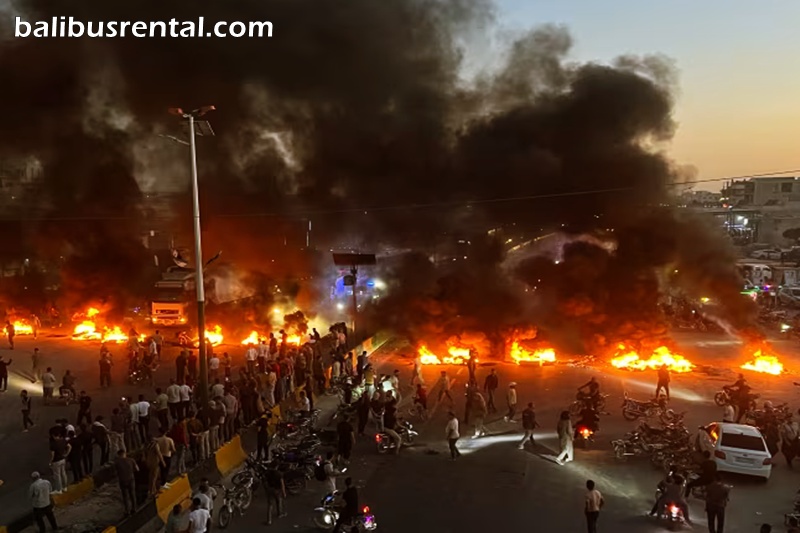
In eastern Syria, a man frustrated by soaring fuel prices turns toward a crowd recording him on their phones and addresses the country’s transitional president directly.
“We stood with you, so stand with us,” he shouts. “I swear by God, if things don’t change between now and the new year, the situation will turn into something we won’t want. Enough!”
Security officers stand nearby as he openly criticizes the government. There is no immediate arrest, no attempt to silence him and no visible effort to stop the crowd from recording his words.
What happens next is striking: nothing.
The scene captures one of the most significant changes in Syria since the fall of Bashar al-Assad. For decades, Syrians learned to measure every public word against the possibility of surveillance, detention and violence. Under Assad’s 54-year rule, open criticism of the government could carry devastating consequences, including imprisonment, torture, disappearance or death.
Now, people can stand in public, criticize government policies and record their complaints on smartphones without necessarily being detained.
That political transformation, however, has created a difficult new test for Syria’s transitional government. Political freedoms have expanded far more rapidly than living standards have improved, leaving millions of Syrians confronting a frustrating contradiction: they can speak more freely about their problems, but many of those problems remain stubbornly unresolved.
Earlier this month, thousands of Syrians took to the streets in the broadest protests since Assad’s fall nearly two years ago. Unlike demonstrations during the Assad era, when state forces routinely crushed dissent and state-controlled television attempted to discredit protesters, the demonstrations were widely shown on state media.
The contrast was particularly striking because Assad’s government had routinely portrayed demonstrations as foreign conspiracies. During the uprising against his rule, state television promoted claims that protests were being staged from studios outside Syria, including in Qatar, in an effort to undermine the credibility of demonstrators.
The new government’s decision to allow public criticism represents an important political shift. But it also means the authorities are now operating in an environment where citizens can openly express their anger, organize demonstrations and demand results.
That freedom could become increasingly difficult to manage if economic conditions fail to improve.
Fuel prices expose the depth of Syria’s economic crisis
The latest protests were triggered by a government decision to increase fuel prices by as much as 40%. Officials attributed the increases to the international energy crisis associated with the war involving Iran, arguing that higher global costs were placing additional pressure on Syria’s already fragile finances.
For ordinary Syrians, however, higher fuel prices have consequences far beyond the cost of filling a vehicle.
Fuel is tied directly to transportation, food distribution, electricity generation, agriculture and the price of basic goods. When fuel becomes more expensive, the costs of transporting food and merchandise rise, businesses face higher operating expenses and households can find that their purchasing power falls even further.
As public anger intensified, the government partially reversed the increases and sent its energy minister before parliament. The move was presented as an example of political accountability and responsiveness to public pressure.
Analysts have viewed that response as an important test of the new government’s ability to react to popular discontent. Yet reversing part of a fuel-price increase cannot solve the deeper economic problems inherited from decades of war, corruption, destruction and international isolation.
The World Bank estimates that around two-thirds of Syrians live below the lower-middle-income poverty line, surviving on less than $3.65 a day.
That means even relatively modest increases in the price of fuel, food or transportation can have an immediate effect on household budgets.
“We’re going to see these protests happening over and over again,” Ibrahim al-Assil, director of the Harvard Kennedy School’s Syria in Transition Lab, told CNN. “It’s virtually impossible to overcome these severe economic challenges that Syrians are suffering. It will gradually become more challenging.”
The problem is therefore not simply that Syrians want the new government to deliver an economic recovery. It is that expectations for rapid change have risen dramatically following Assad’s departure.
The end of the honeymoon
The transitional government inherited an economy devastated by more than a decade of war and decades of authoritarian rule.
Infrastructure has been destroyed or badly degraded. Electricity supplies remain inadequate in many areas. Businesses have limited access to capital. Millions of Syrians remain poor, displaced or dependent on humanitarian assistance. The state itself has limited financial resources with which to address those problems.
At the same time, the fall of Assad generated enormous expectations.
For Syrians who supported the political transition, the end of the old regime was not simply the removal of one leader. It represented the possibility of a completely different country — one with political freedom, functioning institutions, economic opportunity and a chance to rebuild normal lives.
That creates a difficult political equation for President Ahmed al-Sharaa.
“The honeymoon period was always going to come to an end,” Charles Lister, director of the Syria Initiative at the Middle East Institute in Washington, told CNN. “People’s expectations were going to rise, and their patience was going to wear thin if those expectations weren’t met. That’s basically where we are.”
The government is therefore facing a race against time. It needs to demonstrate that political change can eventually translate into improvements in everyday life before frustration undermines public support for the transition.
A $216 billion reconstruction challenge
Al-Sharaa is attempting to rebuild a country whose reconstruction needs are estimated by the World Bank at roughly $216 billion.
The scale of that task is enormous. Roads, bridges, hospitals, schools, power stations, water systems, telecommunications networks, factories and transportation infrastructure all require investment.
Yet the transitional government inherited a state with severely depleted finances. Years of economic mismanagement, corruption and the extraction of wealth by members of Assad’s inner circle left Syria with few domestic resources capable of financing reconstruction on the scale required.
As a result, the government has made international investment a central part of its economic strategy.
Al-Sharaa has sought to bring Syria back into the international system after years of diplomatic isolation. His government has worked to establish relations with countries that had previously opposed or sanctioned Damascus, while presenting Syria as a potential destination for investment and a strategic partner in a rapidly changing Middle East.
“Syria has restored its status into the international community,” al-Sharaa told the UN General Assembly. “It has been a transit for the world. We also built diplomatic bridges and we proved to the world that the security of the region has to start in Damascus.”
The new diplomatic engagement has produced some significant results.
Perhaps the clearest example is al-Sharaa’s relationship with US President Donald Trump, whom he has met four times since May. The United States has subsequently lifted its sanctions on Syria, removing one of the most significant barriers to international business activity and investment.
Turkey, Qatar, Saudi Arabia and the United Arab Emirates have been among the most important foreign investors and economic partners. Syria estimated last year that commitments from those countries totaled around $28 billion.
The European Union has committed $2.7 billion in support, while France has also pursued economic and infrastructure cooperation. During French President Emmanuel Macron’s July visit to Damascus, the two countries announced new agreements covering areas including transportation and infrastructure.
The diplomatic outreach has been extensive. One Syria expert estimates that representatives of the new government have met officials from roughly 100 countries since taking power.
Al-Sharaa has also pursued a pragmatic foreign policy by maintaining relations with countries on opposing sides of major geopolitical disputes. Syria continues to engage with Russian President Vladimir Putin, whose government was a major supporter of Assad, while also maintaining relations with Ukrainian President Volodymyr Zelensky.
The message from Damascus is clear: Syria wants to avoid being locked into a single geopolitical camp and instead use its strategic importance to attract investment and diplomatic support from multiple directions.
Syria’s geography could become an economic asset
Syria’s location is one of its greatest potential advantages.
The country occupies a strategically important position between the Mediterranean and the heart of the Middle East. Its territory provides potential connections between the Gulf, Iraq, Turkey, the Mediterranean and European markets.
During the civil war, Syria’s geography helped turn the conflict into an international crisis. Refugees moved across the region and into Europe, extremist organizations expanded their operations and neighboring countries became directly involved in the conflict.
The hope now is that the same geography can work in reverse.
A stable Syria could become an important transportation and trade corridor, potentially encouraging investment, facilitating refugee returns and reducing the space available to extremist groups.
The Iran war has given that strategy additional urgency. Al-Sharaa has promoted Syria as a modern version of a Silk Road, presenting the country as a potential land bridge connecting energy-producing states in the east with Mediterranean markets.
That could provide an alternative route for some trade and energy flows that currently depend heavily on vulnerable maritime chokepoints such as the Strait of Hormuz and Bab al-Mandeb.
There are already signs of that ambition becoming reality. Thousands of tanker trucks carrying oil from southern Iraq are crossing Syrian territory toward the Mediterranean port of Baniyas.
For Damascus, such traffic is more than a source of transit revenue. It represents a demonstration of what Syria could become if its infrastructure is restored and its security environment stabilizes.
But the economic benefits remain far removed from the daily experience of most Syrians.
Big investments, small improvements
One of the central challenges facing the transitional government is the time gap between announcing an investment and producing measurable improvements in people’s lives.
A new highway, port project, airport renovation or power plant can require years to complete. Even once finished, its economic benefits may take additional time to spread through the broader economy.
That is little comfort to a family struggling to afford fuel today.
Lister argues that many of the major international projects being discussed in Syria are effectively 10-year strategic investments.
“They’re not going to reduce the price of bread, or immediately bring in more fuel or reduce the cost of fuel in Syria,” he said.
The end of US sanctions, however, could create opportunities that operate on a shorter timeline. Lister says smaller and medium-sized investments could generate employment more quickly, allowing Syrians to experience some economic benefits before massive infrastructure projects are completed.
“It’s those kinds of projects that offer a far greater chance of starting to put the seeds in the ground that lead to an amelioration of the challenges ordinary Syrians face,” he said.
“But it’s not going to result in those things being fixed next week. It’s probably going to take another year or two.”
That distinction is crucial for the government. International investors may evaluate Syria over five, 10 or 20 years. Ordinary citizens often have to decide whether they can afford food, transportation and electricity this week.
‘Let your people live’
Karam Shaar, a Syrian political economist who runs an advisory firm, estimates that only around 5% of promised investment deals have made tangible progress.
Among the most visible projects are renovations to Syria’s power infrastructure and Damascus airport by UCC Holding, led by Syrian-Qatari businessmen the Al-Khayyat brothers.
Shaar says the broader economy is recovering, but argues that macroeconomic improvement is not necessarily what matters most to households.
“The economy is undoubtedly recovering. But that’s never the question for the average person. What matters to them is whether their livelihoods are improving,” he told CNN.
That sentiment was reflected in comments from Syrian protester Bassam Al-Ali, who told Reuters that the government appeared too focused on large projects while ordinary citizens were struggling with the cost of living.
“We do not want roundabouts,” he said, criticizing what he described as spending on visible infrastructure projects while basic living conditions remain difficult. “Let your people live.”
His complaint highlights a fundamental political problem for the transitional government.
Large infrastructure projects are highly visible symbols of reconstruction. They can demonstrate that foreign investors are returning and that the government is capable of attracting capital.
But they do not necessarily translate immediately into higher wages, cheaper food or reliable electricity.
For citizens who endured years of war and economic deprivation, patience may depend less on the number of international agreements signed in Damascus than on whether they can actually feel an improvement in their household finances.
Al-Assil warns that this could eventually affect the political legitimacy the new leadership gained from the revolution.
The government cannot rely indefinitely on the symbolic achievement of having removed Assad, he argues. As time passes, its legitimacy will increasingly depend on its ability to deliver functioning institutions and give citizens a meaningful role in shaping the country’s future.
“Buying patience from people requires allowing them to participate, making them feel that their voices are heard,” al-Assil said.
The unresolved Israel question
Even if Syria succeeds in attracting investment and improving living standards, another major obstacle remains — one largely outside Damascus’ control.
That obstacle is Israel.
Al-Sharaa directly raised the issue at the UN General Assembly, arguing that Syria’s reintegration into the international community is being undermined by continued Israeli military action.
“The world is joyed about our return. But Israel is launching attacks against Syria,” he said. “This is at odds with the orientation we’re seeing at the global level.”
Al-Sharaa estimated that Israel had carried out nearly 500 strikes in Syria since he took power. Israel also maintains control over areas of southern Syria, and Israeli officials have said their forces intend to remain there indefinitely.
Israel says it does not trust al-Sharaa and argues that maintaining a security buffer is necessary to prevent attacks and protect Israeli territory.
For Syria, the situation is different. After years of civil war and economic collapse, Damascus has little interest in entering another major conflict with a neighboring country.
The two sides have been engaged in direct negotiations since August of last year, although progress has repeatedly been interrupted.
Al-Sharaa said at an Atlantic Council panel in New York that the negotiations had reached “90% of agreements” before Israel withdrew for what he described as various reasons.
The dispute has significant implications beyond security.
Foreign investors considering projects in Syria must assess not only the country’s economic prospects but also the possibility of renewed regional instability. A major escalation involving Israel could undermine infrastructure, disrupt trade routes and increase the perceived risks of doing business in the country.
Lister says investors repeatedly raise the issue when discussing Syria’s economic prospects.
“If the Israelis continue their current posture after their elections (in October), then more and more external investment into Syria is less likely – because they are waving this massive hammer over the head of Damascus,” he said.
“This particular issue is just as central to the questions around economic recovery as sanctions, as investment prospects, as small and medium-sized enterprises. Israel is just as important.”
A new political bargain
Syria is therefore entering a new and uncertain phase.
The country has achieved something that would have been difficult to imagine under Assad: citizens can publicly criticize the government, protests can be broadcast on state television and officials can be forced to respond to public anger.
But political freedom also changes the expectations placed on those in power.
Under Assad, economic hardship was compounded by repression and the absence of meaningful avenues for public criticism. Under the transitional government, Syrians can increasingly voice their frustrations — which means those frustrations are harder for the authorities to ignore.
That creates a new political bargain.
The government is asking citizens to be patient while it rebuilds a country devastated by war. Citizens, meanwhile, are asking the government to demonstrate that patience will eventually be rewarded.
For now, al-Sharaa’s international outreach has produced diplomatic recognition, sanctions relief and investment commitments. But those achievements remain largely promises for the future for many Syrians.
The man shouting about fuel prices in eastern Syria illustrates the challenge facing the transitional government. He is not demanding the return of the old regime. He is not necessarily rejecting the political transition. Instead, he is asking the new leadership to deliver on the expectations that accompanied Assad’s fall.
“We stood with you, so stand with us.”
That may prove to be one of the defining demands of Syria’s next chapter: not simply freedom from the old system, but visible improvements in the lives of the people who helped bring it to an end.