Thursday | 3rd September 2026
It is a question President Donald Trump has privately been asking members of his national security team for months: Why aren’t the Iranian people rising up to topple their leaders?
At the beginning of the war, Trump appeared relatively confident that sustained Israeli and American military strikes would trigger widespread unrest inside Iran. He had been encouraged by Israeli Prime Minister Benjamin Netanyahu, who argued that an intensive campaign against Iran could create the conditions for street protests in Tehran and potentially threaten the survival of the Islamic Republic.
The expectation was that military pressure from outside the country, combined with Iran’s existing economic difficulties and long-running public dissatisfaction with the government, could produce a political crisis from within.
But not everyone in Washington shared that assessment.
Other US officials had reviewed intelligence indicating that a foreign military campaign was unlikely, by itself, to generate the kind of mass uprising necessary to remove Iran’s leadership. According to people familiar with the discussions, the question of whether military action could actually produce regime change was intensely debated inside the administration before the first strikes were launched.
Despite those reservations, Trump went ahead with the conflict in late February while explicitly encouraging Iranians to challenge their government.
“This will be probably your only chance for generations,” Trump told the Iranian people in a video message on the night the war began.
His appeal appeared to reflect an ambitious early objective: weaken Iran militarily, encourage popular opposition and ultimately create the possibility of a new government in Tehran.
From regime change to negotiations over Hormuz
That objective, however, quickly faded from the center of the administration’s public messaging.
As the war progressed, the immediate priority became the Strait of Hormuz, one of the world’s most strategically important waterways. The strait is a critical route for global energy shipments, and disruption there threatened to create broader economic consequences far beyond Iran and the Middle East.
Washington therefore shifted toward negotiations with Tehran, particularly efforts to restore shipping through the waterway.
By June, Trump was publicly distancing himself from the idea that regime change had ever been a major American objective.
“I never cared about regime change,” he said, while describing Iranian negotiators as “very rational people.” Trump also argued that American efforts to overthrow foreign governments historically had a poor record of success.
Yet privately, according to people familiar with the matter, Trump continued to question why his calls for Iranians to overthrow their government had not produced the response he expected.
Now, with shipping traffic through the Strait of Hormuz still significantly below pre-war levels and diplomatic efforts with Iran largely stalled, Trump appears to have returned to the same idea that characterized the beginning of the conflict.
“When are the Iranian people going to rise up and fight?” he asked on social media Tuesday.
The question underscored the unresolved tension at the heart of Trump’s Iran strategy: whether military and economic pressure will eventually cause the Iranian government to lose control, or instead strengthen its determination to suppress internal opposition.
A familiar pattern in the ongoing war
The renewed discussion of regime change represents another turn in what has become a familiar pattern throughout the war.
The conflict has repeatedly moved between intense military confrontation, periods of relative calm and renewed escalation. A month-long stretch of comparatively limited fighting was disrupted this week when the United States and Iran exchanged strikes for three consecutive days.
The sequence resembled earlier periods of the conflict, when one side’s military action was followed by retaliation and then another round of escalation.
Trump has repeatedly threatened to target Iran’s civilian infrastructure and has warned that the United States could launch substantially larger attacks if Tehran continues to resist American demands.
“It was a very heavy attack last night and we’re prepared to do another one any time we want,” Trump said Wednesday.
At the same time, he suggested that he did not expect the latest confrontation to continue indefinitely.
The contradictory messages illustrate the uncertainty surrounding the administration’s long-term objectives. Trump has alternated between threatening overwhelming military action, expressing confidence in America’s position and suggesting that negotiations could eventually resolve the conflict.
For now, however, there appear to be few substantive efforts to restart diplomacy.
Trump ordered his envoys to halt discussions with Iran last month, and officials say there is currently no major diplomatic initiative underway. Rather than pushing publicly for an immediate settlement, Trump has indicated that he is comfortable with the current balance of power.
“I like our position now,” he wrote on social media, pointing to what he described as “almost total control of the Hormuz Strait” and an Iranian economy that was “totally collapsing.”
The political clock is also ticking
There is another consideration hanging over the conflict: American domestic politics.
Many people in Trump’s political orbit would prefer the Iran war to recede from the headlines during the next two months, as American voters begin casting ballots in elections that will determine the balance of power on Capitol Hill.
The upcoming midterm elections could become an important political test for the administration. Republicans are aware that a prolonged or intensifying conflict could create economic and political problems, particularly if it contributes to higher energy prices, disruptions in global trade or further instability in financial markets.
Trump has repeatedly rejected the suggestion that the elections are influencing his decisions on Iran.
“I don’t know how much more they can take, but, you know, whatever it is, it doesn’t matter,” Trump said Wednesday when discussing Iran.
“And I’m not affected by the election,” he added.
Nevertheless, senior advisers and Republican allies in Congress have privately and publicly warned that renewed fighting could become politically damaging. The longer the conflict continues, the greater the possibility that voters will judge the administration not only on national security but also on the economic consequences of the war.
A strategic shift toward economic pressure
While the administration has not abandoned military pressure, its strategy has increasingly included efforts to squeeze Iran economically.
The goal is to restrict Tehran’s access to money, weaken its ability to finance the government and military and make it more difficult for Iranian authorities to withstand international pressure.
The Treasury Department has threatened sanctions targeting some of Iran’s most important trading partners and financial channels. The administration has yet to implement the most severe measures it has discussed, but the threat itself is part of a broader effort to isolate Iran economically.
There is also a political calculation behind that strategy.
By worsening economic conditions, some members of Trump’s team hope that ordinary Iranians will become increasingly angry with their government. The theory is that economic hardship could transform existing dissatisfaction into large-scale political unrest.
US officials acknowledge, however, that such a strategy carries a significant cost for ordinary Iranians. Sanctions and financial restrictions do not exclusively affect government officials or military institutions. They can also increase the price of food, medicine, fuel and other basic necessities.
Iran is already experiencing significant economic pressure.
Inflation has surged, food prices have continued to rise and the Iranian rial has lost substantial value. Iranian officials themselves have acknowledged the severity of the economic situation.
“We are apologetic that these problems exist, as we find ourselves in a full-scale economic, military, and security war,” Iranian President Masoud Pezeshkian said before the latest Treasury Department measures were announced, according to Iranian state media.
The worsening economic conditions provide fertile ground for political discontent. But economic hardship does not automatically translate into a successful uprising.
Why haven’t protests toppled the Iranian government?
This is where the expectations of the Trump administration encounter a difficult reality.
Some US officials say there is little intelligence suggesting that a renewed nationwide uprising capable of overthrowing Iran’s leadership is imminent, even as the country’s economic conditions deteriorate.
American intelligence assessments conducted before the war reportedly concluded that a joint US-Israeli military campaign was unlikely to produce regime change on its own.
Months into the conflict, American officials have also concluded that Iran’s leadership has retained its grip on power.
That resilience is partly rooted in the government’s extensive security apparatus. Iranian authorities have repeatedly demonstrated their willingness to use arrests, intimidation and lethal force against demonstrators.
The country has experienced several major waves of protests over the past two decades. Yet previous demonstrations have generally failed to produce the collapse of the Islamic Republic.
Western sanctions have also failed to achieve the political transformation successive American administrations once hoped they might produce.
Despite years of economic isolation, Iran’s political system has survived. The government has adapted to sanctions, developed alternative trade networks and relied on a combination of state institutions, security forces and political loyalists to maintain control.
Protests have often been met with severe crackdowns.
That pattern was evident again at the beginning of this year, when Iranian authorities launched one of the harshest crackdowns in the history of the Islamic Republic.
The experience has created a difficult environment for organized opposition. Even Iranians who are deeply dissatisfied with the government may hesitate to participate in protests if they believe doing so could result in imprisonment, injury or death.
Tehran understands the strategy
Iranian leaders also appear to understand what Washington hopes to achieve.
Rather than viewing the economic campaign simply as an attempt to force Tehran back to the negotiating table, Iranian officials increasingly see sanctions and military pressure as parts of a broader strategy aimed at weakening the government from within.
Hamidreza Azizi, a senior Iran analyst at the International Crisis Group, said Iranian leaders understand that economic pressure could eventually be connected to domestic unrest.
“The Iranian leadership sees this kind of economic campaign of economic pressure not in isolation, but as part of a broader campaign by the United States,” Azizi said.
From Tehran’s perspective, the objective may ultimately be to force Iran either to make major concessions to Washington or to create conditions that could eventually lead to political change.
That perception could make Iranian officials even more reluctant to compromise.
If the government believes that economic negotiations are merely one component of a broader campaign for regime change, Iranian leaders may conclude that making concessions would weaken them without guaranteeing an end to American pressure.
Will the US arm Iranian dissidents?
Trump has also left open another potentially consequential option: providing assistance to Iranian opposition groups.
When asked this week whether the United States might, perhaps through the CIA, provide weapons or other assistance to Iranian dissidents seeking to overthrow the government, Trump declined to give a direct answer.
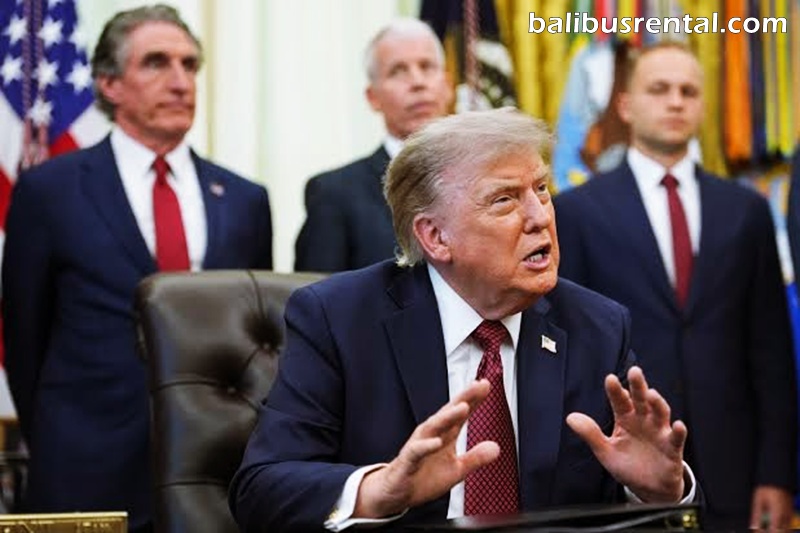
“I’d love to tell you that,” he said Wednesday in the Oval Office, “but it wouldn’t be appropriate to say.”
The carefully worded response is likely to fuel further speculation about whether the administration is considering covert support for groups opposed to Iran’s government.
Such a policy would represent a significant escalation beyond economic sanctions and military strikes. It could also carry substantial risks, including retaliation against American interests and accusations that Washington is attempting to engineer a foreign government.
For Iran’s leadership, the possibility of American support for dissidents would reinforce its longstanding argument that domestic opposition is being encouraged or manipulated by foreign powers.
The contradiction at the center of Trump’s strategy
Perhaps the most striking part of Trump’s renewed focus on regime change is that he appears to understand why Iranians have not responded to his calls in the way he hoped.
After asking why Iranians were not rising up against their leaders, Trump acknowledged the danger facing protesters.
“I understand their plight,” he said. “They’re being shot right now.”
That admission captures the central contradiction confronting Washington.
The United States may be able to impose enormous military and economic costs on Iran, but translating that pressure into political change is far more difficult.
For an uprising to succeed, protesters would need to overcome the government’s security forces, organize on a nationwide scale and maintain momentum despite the enormous risks involved. They would also need some degree of coordination and leadership capable of providing an alternative political structure.
None of those conditions can be guaranteed by foreign military power.
Indeed, external attacks can sometimes have the opposite effect. Faced with a foreign enemy, citizens who strongly oppose their government may still rally around the state out of nationalism or fear of national collapse.
That creates a fundamental dilemma for Trump’s strategy.
The more aggressively Washington attacks Iran, the greater the pressure on Tehran. But the same pressure could also make the Iranian government more determined to suppress dissent and portray protesters as collaborators with an external enemy.
An uncertain endgame
Six months after Trump entered the war calling on Iranians to seize what he described as a historic opportunity, the promised uprising has not materialized.
Instead, Iran’s government remains in power, the economy is under severe strain and the Strait of Hormuz remains at the center of the conflict.
Diplomacy has stalled, military exchanges have resumed and Washington is considering additional economic pressure.
Trump’s latest comments suggest that regime change, despite having been publicly dismissed earlier in the conflict, remains an idea he has not abandoned.
The central question is whether economic collapse and continued military pressure will eventually produce the political upheaval Trump has been anticipating—or whether Iran’s leadership will continue to absorb the pressure while suppressing dissent.
For now, there is little evidence that the outcome is close to being decided.
The war has demonstrated that the United States can inflict enormous damage on Iran. What remains far less certain is whether Washington can turn that military advantage into the political transformation that Trump initially appeared to expect.