Wednesday | 13rd May 2026
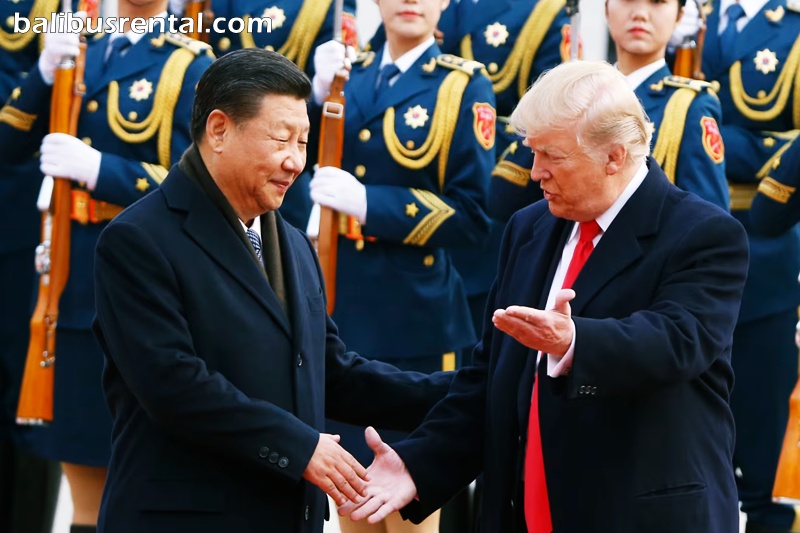
Beijing and Washington are preparing for one of the most consequential diplomatic meetings in recent years as Donald Trump arrives in China for high-level talks with Chinese President Xi Jinping. The visit represents far more than a ceremonial summit between two world leaders. It is being viewed as a pivotal moment that could redefine the future of relations between the world’s two largest economies and determine the direction of an increasingly tense global order.
The stakes surrounding the visit are exceptionally high. Trade disputes, technological rivalry, military tensions in Asia, competition over critical minerals, and the status of Taiwan are all expected to dominate discussions. Yet looming above every agenda item is the ongoing war involving the United States and Iran, a conflict that has dramatically altered the geopolitical environment in which the summit is taking place.
Trump’s arrival marks the first visit by a sitting American president to China since his own previous trip to Beijing in 2017. However, both countries — and the world itself — have changed profoundly since then.
At the time of Trump’s first visit, Washington and Beijing were still attempting to manage competition while preserving economic cooperation. Today, the relationship is defined by strategic rivalry, technological decoupling, and growing distrust. The global landscape has become increasingly fragmented, with alliances hardening and economic blocs competing for influence.
China, in particular, has undergone a dramatic transformation over the past decade. After being targeted by tariffs and technology restrictions during Trump’s earlier administration, Beijing accelerated efforts to reduce dependence on the United States. Chinese leaders poured resources into advanced manufacturing, artificial intelligence, green energy, robotics, semiconductor development, and domestic supply chains. Those investments have helped China evolve into a technological powerhouse capable of competing directly with the US in critical industries.
At the same time, Xi has consolidated political power to an extent not seen in China for decades. By removing presidential term limits and strengthening Communist Party control across society, Xi has established himself as the country’s dominant political figure. Trump, meanwhile, enters the talks after reshaping American foreign policy around a more nationalist and transactional approach while serving what US law defines as his final presidential term.
Against this backdrop, both leaders are approaching the summit with very different priorities — but also with a shared understanding that the outcome could have enormous global consequences.
The meetings themselves are expected to combine diplomacy with grand symbolism. Chinese officials have arranged elaborate ceremonies designed to showcase Beijing’s stature on the world stage, including a state banquet and a tour of the historic Temple of Heaven, reflecting the type of pageantry Trump has long appreciated during international visits.
For Trump, the trip is unfolding under far more difficult circumstances than originally envisioned.
Following a major summit in South Korea last year, Washington and Beijing had made tentative progress toward easing tensions. Discussions over tariffs, trade agreements, and economic cooperation created hopes that relations might stabilize after years of confrontation. A follow-up summit initially planned earlier this year was expected to focus primarily on economics and national security.
But the expanding conflict involving Iran disrupted those plans.
Trump had delayed his China trip in hopes that the war would be resolved quickly, believing a ceasefire or negotiated settlement could be achieved within weeks. Instead, the conflict has dragged on for months, fueling instability across global energy markets and raising fears of broader regional escalation.
Now the war threatens to overshadow nearly every aspect of the summit.
Speaking before departing Washington, Trump indicated that Iran would be central to his conversations with Xi. He suggested that China could play an important role in helping stabilize the situation, particularly because Beijing remains one of the largest consumers of Iranian oil and maintains close ties with Tehran.
The strategic importance of the Strait of Hormuz has made the issue even more urgent. The narrow waterway is one of the world’s most critical oil shipping routes, and disruptions there have sent shockwaves through global markets. Any prolonged closure or escalation would not only hurt Western economies but also severely impact China and many Asian nations that rely heavily on Middle Eastern energy supplies.
Trump appears eager to persuade Xi to pressure Iran into reopening shipping lanes and supporting a broader peace arrangement. However, Beijing’s close relationship with Tehran complicates the situation.
Only days before Trump’s arrival, Iranian Foreign Minister Abbas Araghchi traveled to Beijing for consultations, underscoring the depth of cooperation between China and Iran. American intelligence officials have also reportedly expressed concern that China may be considering expanded military assistance to Tehran, including air defense systems, though Beijing has denied providing weapons during the conflict.
Washington has simultaneously increased pressure on Chinese-linked entities accused of facilitating Iranian oil exports. Just before the summit, the US Treasury Department announced sanctions against several individuals and organizations allegedly involved in helping move Iranian oil into Chinese markets.
Despite those tensions, some American officials worry that Xi may enter the talks with greater leverage than Trump.
China’s leadership views the prolonged US military engagement with Iran, combined with domestic political pressures ahead of America’s midterm elections, as a sign that Washington is strategically distracted. Chinese officials reportedly believe the moment offers Beijing an opportunity to secure concessions on issues it considers vital — especially Taiwan.
Taiwan is expected to emerge as one of the summit’s most sensitive topics.
Beijing has long demanded that Washington reduce military support for the self-governing island, which China considers part of its territory. The United States, while officially adhering to the “One China” policy, continues to provide Taiwan with defensive weapons and maintains deliberately ambiguous language about whether it would militarily defend the island in the event of a Chinese attack.
Trump himself acknowledged that Xi would likely push hard on the Taiwan issue during their meetings. Chinese leaders are expected to seek reductions in US arms sales and possibly stronger American language opposing Taiwanese independence movements.
Still, US officials insist that Washington’s longstanding Taiwan policy is unlikely to fundamentally change.
Trade and economic cooperation remain another central focus of the visit.
Senior economic officials from both countries are preparing parallel negotiations aimed at preserving the fragile trade truce established last year. The discussions are expected to cover agriculture, aerospace, energy cooperation, investment frameworks, and market access.
The US delegation includes several prominent American business leaders, among them Tim Cook of Apple and Elon Musk of Tesla and SpaceX. Their participation reflects how deeply intertwined the American and Chinese economies remain despite years of strategic competition.
Both governments are also expected to discuss artificial intelligence, an area increasingly viewed as the defining technological race of the 21st century. The United States and China are competing aggressively to dominate advanced AI development, semiconductor production, and next-generation computing infrastructure.
Trump additionally plans to raise human rights concerns during the talks, including the imprisonment of former Hong Kong media tycoon Jimmy Lai and the detention of Christian religious figures in China.
From Beijing’s perspective, however, the summit represents an opportunity to demonstrate that China is emerging from years of confrontation stronger and more resilient.
Chinese officials believe the country’s strategy of pursuing technological self-sufficiency and supply chain independence has paid off. In Beijing’s eyes, China has weathered trade wars, sanctions, global economic volatility, and energy disruptions while continuing to expand its industrial and technological influence.
China also sees its dominance in rare earth minerals and advanced manufacturing as a powerful source of leverage. Beijing is expected to use that position to push for reduced US export controls on advanced technologies and greater access for Chinese companies to American markets.
Chinese leaders also recognize Trump’s desire to showcase major economic victories to American voters. Large Chinese purchases of US agricultural products, commercial aircraft, and energy supplies could provide Trump with political wins at home — and Beijing may use those opportunities to secure concessions in return.
For Xi, maintaining a stable relationship with Washington remains essential to China’s long-term rise. Chinese officials understand that avoiding direct confrontation with the United States gives Beijing more time to strengthen its economy, expand technological leadership, and increase global influence.
At the same time, Xi may view the Iran crisis as an opening to position China as a global mediator capable of balancing diplomacy and strategic influence. Beijing has increasingly portrayed itself as a potential peacemaker in international conflicts, contrasting its approach with what it describes as America’s more interventionist foreign policy.
Trump, meanwhile, has repeatedly emphasized the personal relationship he shares with Xi, suggesting that strong ties between leaders can help reduce tensions even amid broader rivalry.
Ultimately, both sides appear to be entering the summit with cautious expectations. Neither Washington nor Beijing expects a dramatic breakthrough capable of resolving every dispute dividing the two powers. But even modest progress toward stabilizing relations could significantly impact global markets, geopolitical tensions, and the broader international system.
How Trump and Xi manage this delicate balance — between cooperation and confrontation, rivalry and diplomacy — may shape not only the future of US-China relations, but also the trajectory of global politics for years to come.