Friday | 24th July 2026
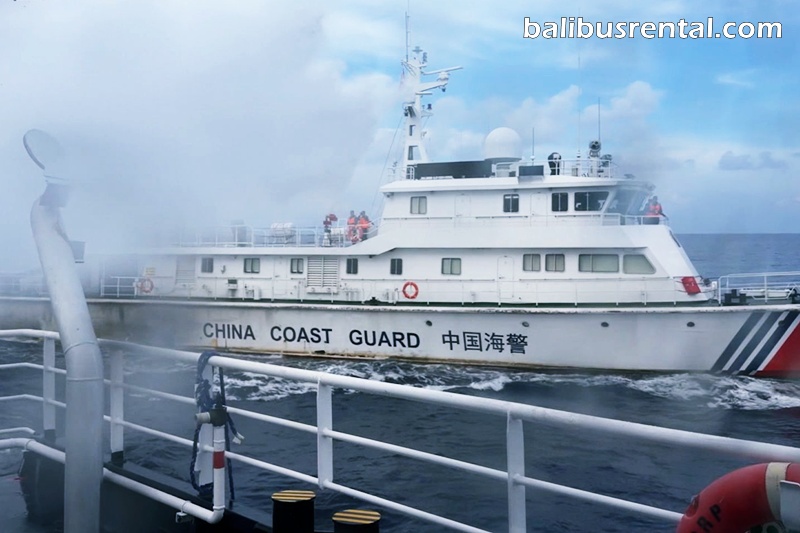
Chinese ships fired water cannon at Philippine vessels, including one carrying a CNN crew, near a dangerous flashpoint in the South China Sea on Friday – the third tense confrontation this week in the contested waters.
According to government estimates:
- China deployed 15 vessels, including Coast Guard ships and members of its so-called maritime militia.
- The Philippines operated 10 government vessels, three belonging to the Philippine Coast Guard.
- A Philippine government surveillance aircraft also flew low above the area during the mission.
The large numerical presence further illustrates China’s ability to maintain near-continuous patrols around disputed maritime features.
China Defends Its Actions
Chinese state media presented a sharply different version of events.
State broadcaster CCTV reported that the China Coast Guard had taken lawful enforcement measures against several Philippine vessels allegedly engaged in illegal activities within Chinese jurisdiction around Huangyan Island—the Chinese name for Scarborough Shoal.
Responding to questions about the incident, Chinese Foreign Ministry spokesperson Lin Jian defended Beijing’s actions, saying China had taken “necessary measures” to safeguard its sovereignty and maritime security.
Chinese officials maintain that their coast guard acted professionally and within domestic law.
Why Scarborough Shoal Matters
At first glance, Scarborough Shoal appears to be little more than an isolated ring of rocks surrounding a shallow lagoon.
However, the area has become one of Asia’s most sensitive geopolitical flashpoints.
Known as Bajo de Masinloc in the Philippines and Huangyan Island in China, the uninhabited shoal lies approximately 220 kilometers west of Luzon, the Philippines’ largest island, and roughly 850 kilometers from China’s Hainan Province.
The surrounding waters provide rich fishing grounds that have supported Filipino fishing communities for generations.
Beyond fisheries, however, Scarborough Shoal occupies an important strategic location within the South China Sea, one of the world’s busiest maritime trade routes. Roughly one-third of global shipping passes through these waters annually, making freedom of navigation critical to international commerce.
China Has Controlled the Shoal Since 2012
Although China, the Philippines and Taiwan all claim sovereignty over Scarborough Shoal, Beijing has exercised effective control over the area since a prolonged maritime standoff in 2012.
Since then, Chinese Coast Guard vessels have maintained an almost constant presence around the shoal, frequently preventing Filipino fishermen and government vessels from accessing the lagoon.
This sustained presence has become a key element of China’s broader strategy to reinforce its claims throughout the South China Sea.
Three Confrontations in One Week
Friday’s incident followed two earlier confrontations earlier in the week.
Clash at Second Thomas Shoal
The first occurred on Monday near Second Thomas Shoal in the Spratly Islands, another disputed area where the Philippines maintains a military outpost aboard the grounded World War II-era ship BRP Sierra Madre.
According to the Philippine military, a China Coast Guard vessel launched a smaller boat toward the outpost. Philippine forces responded by deploying inflatable boats to intercept it.
Video released by Philippine authorities showed Chinese personnel allegedly ramming one of the Philippine boats before both sides exchanged blows using wooden poles, oars and batons.
Two Philippine servicemen were injured during the altercation and required medical treatment.
China rejected the Philippine account, accusing Manila of spreading misinformation and claiming Philippine boats had initiated the confrontation.
Second Water Cannon Incident
Another confrontation followed on Thursday near Scarborough Shoal.
Chinese authorities claimed they expelled two Philippine vessels that had entered Chinese waters illegally.
Philippine officials, however, said Chinese Coast Guard ships used water cannons and dangerous blocking maneuvers while attempting to stop a mission delivering supplies to Filipino fishermen.
Unlike Friday’s mission, Thursday’s operation continued successfully despite Chinese interference.
United States Reaffirms Support
The repeated confrontations have prompted strong responses from the United States.
Following Monday’s clash, the U.S. State Department condemned what it described as China’s dangerous and aggressive actions.
During a regional meeting in Manila on Thursday, U.S. Secretary of State Marco Rubio reiterated Washington’s commitment to the Philippines.
He emphasized that the United States would not abandon its treaty ally and reaffirmed America’s obligations under the Mutual Defense Treaty.
The treaty obligates both countries to assist one another if either is attacked, with many analysts suggesting that attacks on Philippine government vessels could potentially trigger treaty commitments.
This alliance significantly raises the stakes of any confrontation in the South China Sea.
Growing Military Imbalance at Sea
CNN reporters also described the overwhelming difference in size between the opposing vessels.
The Philippine fisheries vessel measured approximately 30 meters in length.
By comparison, the Chinese Coast Guard ship shadowing it overnight stretched roughly 111 meters—nearly four times larger—demonstrating the expanding capabilities of China’s maritime forces.
The disparity reflects Beijing’s broader investment in coast guard and maritime militia fleets, allowing it to project power without deploying naval warships.
Competing Claims Across the South China Sea
Territorial disputes in the South China Sea extend well beyond China and the Philippines.
Vietnam, Malaysia, Brunei and Taiwan also claim various islands, reefs and atolls scattered throughout the 1.4 million-square-mile waterway.
China claims most of the sea under its so-called “nine-dash line,” despite an international arbitration ruling in 2016 that concluded Beijing has no legal basis for claiming historic rights over most of the region.
China rejected the tribunal’s decision and has since continued constructing military facilities, artificial islands, radar installations and airstrips on disputed features.
Global Economic Importance
The South China Sea serves as one of the world’s most critical maritime corridors.
Every year, trillions of dollars worth of global trade—including energy supplies, raw materials, agricultural products and electronics—passes through these waters.
Recent instability in the Persian Gulf has highlighted the vulnerability of global supply chains to maritime disruptions.
Analysts warn that a prolonged conflict in the South China Sea could have even greater economic consequences, affecting shipping routes, international trade, semiconductor production and energy markets worldwide.
Chinese Maritime Activity Continues to Increase
Maritime analysts report that China’s presence around Scarborough Shoal has grown substantially over the past year.
Research by the Asia Maritime Transparency Initiative (AMTI) at the Center for Strategic and International Studies (CSIS) found that Chinese Coast Guard vessels spent 993 ship-days around Scarborough Shoal in June alone—nearly matching the total number recorded throughout all of 2025.
The United States has also expanded its maritime deployments in the Indo-Pacific. Several U.S. Coast Guard vessels previously stationed in Bahrain before the Iran conflict have since been redeployed to the Pacific, reflecting Washington’s increased focus on maintaining stability in the region.
Outlook
The latest confrontation demonstrates that tensions between China and the Philippines show little sign of easing. Although neither side appears eager for open conflict, increasingly frequent encounters involving water cannons, dangerous maneuvers and physical clashes continue to heighten the risk of accidental escalation.
With overlapping territorial claims, expanding military deployments and treaty obligations involving the United States, the South China Sea remains one of the world’s most closely watched geopolitical flashpoints. As maritime patrols intensify and strategic competition grows, even relatively small incidents around disputed features such as Scarborough Shoal could have consequences far beyond the region.