Bali Dance Culture: History, Traditions, Religion, and Traditional Performances
Bali dance culture is one of the most distinctive and fascinating aspects of Balinese heritage. Deeply connected to Hindu religion, traditional ceremonies, mythology, and community life, Balinese dance is much more than a form of artistic entertainment. It is a living cultural tradition that has been passed down through generations and continues to play an essential role in the daily lives of the Balinese people.
Traditional Balinese dance can be seen during temple festivals, religious celebrations, weddings, cremation ceremonies, and other important events in the Balinese calendar. Although visitors can enjoy traditional dance performances at hotels, restaurants, and cultural centers throughout the island, these tourist performances represent only a small part of the rich and diverse world of Balinese performing arts.
For travelers exploring Bali, watching a traditional dance performance offers an opportunity to understand the island’s spiritual beliefs, ancient stories, artistic expression, and strong sense of community. From the dramatic movements of the Baris warrior dance to the graceful gestures of the Legong dance and the colorful characters of the Barong performance, each style reveals a different aspect of Bali’s cultural identity.
History of Balinese Dance
The history of Balinese dance stretches back many centuries. References to performing arts appear in historical inscriptions from the ninth century, indicating that theatrical entertainment and traditional performances were already established in Balinese society. Early references include wayang, the traditional shadow puppet theatre, and topeng, a performance art involving masks and dramatic characters.
Gamelan music, which provides the rhythmic and melodic foundation for many Balinese dance performances, has a long history in the Indonesian archipelago. Its instruments, musical structures, and performance traditions developed over many centuries, becoming closely associated with religious ceremonies, royal courts, and village celebrations.
Much of classical Balinese performing art was influenced by Java, particularly through the movement of religious ideas, literature, court traditions, and artistic practices between the two islands. These influences helped shape the distinctive combination of refined movements, elaborate costumes, expressive gestures, and dramatic storytelling that characterizes traditional Balinese dance today.
The Influence of the Majapahit Kingdom
The expansion of the Majapahit kingdom and its influence on Bali during the fourteenth century contributed to the development of Balinese court culture. Javanese literary traditions, Hindu religious concepts, courtly customs, and theatrical forms became important elements of the island’s cultural life.
Over time, these influences blended with existing Balinese traditions to create a distinctive artistic identity. Royal courts and local ruling families supported performances that combined religious symbolism, sophisticated choreography, music, and stories drawn from Hindu epics and ancient Javanese literature.
The Ramayana and Mahabharata became important sources of inspiration for Balinese dance and drama. These epics tell stories of heroes, gods, moral conflicts, loyalty, and the struggle between good and evil. Their characters continue to appear in traditional dance, shadow puppetry, masked theatre, and modern stage productions.
Ancient Javanese literary language, known as Kawi, also remains part of traditional Balinese performance. While the main narrative may be delivered in Kawi, comic characters often explain the story and comment on its meaning in everyday Balinese. This combination allows performers to preserve classical literature while making the stories accessible to local audiences.
Following the spread of Islam across much of Java from the fifteenth and sixteenth centuries onward, Bali continued to preserve and develop many Hindu-Javanese artistic and literary traditions. These traditions evolved within Balinese religious and social life, eventually becoming an important part of what is recognized today as classical Balinese culture.
The Development of Modern Balinese Dance
The arrival of colonial rule and the transformation of Bali’s traditional political structures changed the way dance and drama were supported. As royal courts lost much of their former influence, village communities, temple organizations, and local artistic groups became increasingly important in maintaining and developing performing arts.
Tourism also contributed to the evolution of Balinese dance. During the twentieth century, performers and musicians developed new styles that could be presented to wider audiences while retaining important elements of traditional Balinese aesthetics.
The 1930s and the decades following the Second World War were particularly significant for the development of modern Balinese performing arts. Traditional narrative theatre continued, while new solo and group dances became increasingly popular. One of the most influential developments was gong kebyar, a dynamic musical style characterized by sudden changes in tempo, powerful rhythms, contrasting dynamics, and energetic ensemble playing.
Gong kebyar encouraged more dramatic choreography and expressive movements, helping dancers demonstrate technical skill, precision, and emotional intensity. It remains one of the most recognizable musical traditions associated with Balinese dance.
During the 1960s and 1970s, large-scale dance dramas known as sendratari became increasingly prominent. These productions combined dance, music, costumes, and theatrical storytelling to present stories from the Ramayana, Mahabharata, and other historical or legendary narratives.
Today, Balinese dance continues to evolve through traditional village groups, cultural institutions, schools, festivals, and contemporary performances. Although choreography and presentation may change, the connection between dance, community, religion, and cultural identity remains central to the tradition.
Balinese Dance and Hindu Religion
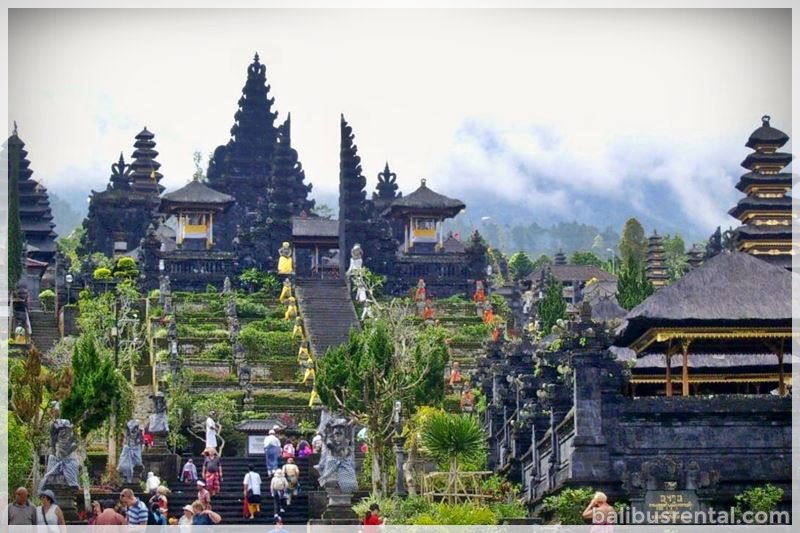
Religion is at the heart of traditional Balinese dance. In Bali, Hindu religious beliefs influence not only temple ceremonies and daily offerings but also music, architecture, sculpture, and performing arts.
For many Balinese dancers, a performance is an act of devotion as well as an artistic expression. Before dancing, performers may pray at family shrines or make offerings to seek blessings, concentration, and taksu. This Balinese concept refers to a special quality of spiritual inspiration, charisma, or artistic energy that enables a performer to communicate powerfully with an audience.
Even performances prepared for tourists may begin with offerings, reflecting the continuing importance of religious customs in the performing arts. In traditional settings, these practices express respect for the gods, ancestors, and spiritual forces believed to influence the harmony of the world.
Balinese dance serves several important religious and ceremonial functions.
1. Dance as a Medium for Spiritual Presence
Certain traditional dances are associated with trance and the belief that spiritual forces can enter or act through a performer. These performances are usually connected to specific ceremonies and community traditions rather than ordinary entertainment.
Two examples are Sang Hyang Dedari and Sang Hyang Jaran.
Sang Hyang Dedari is a sacred trance dance traditionally associated with young girls who enter a trance-like state during a ritual performance. In some traditions, the dancers are believed to become a medium for benevolent spiritual beings.
Sang Hyang Jaran is another sacred trance dance in which a performer, associated with a horse figure, may move through or around burning coconut husks. The performance is connected to ritual beliefs concerning protection, purification, and the relationship between humans and the spiritual world.
These dances demonstrate how Balinese performing arts can combine movement, music, ritual, and collective religious experience.
2. Dance as a Welcome for the Gods
Some Balinese dances are performed to welcome divine beings during temple ceremonies and religious festivals. Their movements express respect, devotion, and hospitality toward the spiritual guests believed to attend these occasions.
Pendet is widely recognized for its graceful gestures and the use of flower offerings. Traditionally associated with sacred welcoming rituals, it is now also performed in cultural presentations and tourism events.
Rejang is a ceremonial dance performed by groups of women, often during temple festivals. Its gentle movements and coordinated formations express devotion and communal participation.
Sutri is another traditional dance associated with particular Balinese ceremonial settings. Its form and function may vary according to local customs and the traditions of the community performing it.
These dances demonstrate the close relationship between religious ceremonies and the artistic life of Balinese villages.
3. Dance as an Offering of Entertainment to the Gods
Other traditional performances provide entertainment within a religious setting. Through dramatic stories, music, humor, and expressive movements, these performances contribute to the ceremonial atmosphere.
Topeng, or masked dance theatre, features performers wearing masks to portray kings, elders, servants, and other characters. Some performances tell historical or legendary stories, while others use humor to discuss social behavior and moral values.
Wayang, particularly traditional shadow puppet theatre, presents stories from Hindu epics and other literary traditions. Accompanied by music and guided by a puppeteer known as the dalang, wayang combines storytelling, symbolism, music, and spiritual meaning.
In certain ritual performances, the dalang also has ceremonial responsibilities, including the preparation or consecration of holy water. This illustrates how performing arts can be closely connected with religious practice.
The Role of Dance and Drama in Balinese Ceremonies
Balinese dance and drama often reflect the ceremonies taking place within a village or family. Performances may be selected to suit the occasion, the religious significance of the event, and the traditions of the local community.
During weddings, performances may include stories about marriage, relationships, loyalty, and family life. In certain cremation or death-related ceremonies, dramatic narratives may explore journeys through the spiritual world, the consequences of human actions, and the transition between life and death.
Traditional theatre is also an important way of preserving Balinese cultural knowledge. Stories, legends, religious teachings, historical memories, and social values are passed from one generation to the next through performances that combine entertainment with education.
Comic characters known as penasar play an especially important role in some forms of traditional theatre. They often serve as attendants, interpreters, or commentators who help audiences understand the main narrative.
While important characters may speak in Kawi or other formal literary registers, the penasar generally use everyday Balinese. Their humorous remarks make complex stories easier to understand, while their commentary may address morality, religious obligations, social relationships, and everyday community concerns.
This mixture of classical storytelling and local humor is one of the distinctive features of Balinese theatre. It enables traditional performances to remain meaningful to contemporary audiences without losing their connection to the past.
The Characteristics of Traditional Balinese Dance
Balinese dance is famous for its precise movements, expressive faces, intricate hand gestures, and coordinated relationship between the body and the music. Every movement has a purpose, and even small changes in posture or facial expression can help communicate a character’s personality, emotions, or spiritual significance.
Unlike dance styles that emphasize large leaps or continuous traveling movements, many traditional Balinese forms focus on controlled body positions, sharp accents, rhythmic changes, and detailed gestures. The overall effect is energetic, dramatic, and visually captivating.
Body Posture and Movement
A characteristic feature of Balinese dance is the semi-bent position of the knees, which allows dancers to maintain a grounded stance while moving with agility. The torso may shift from side to side as the arms extend, bend, and change direction.
The elbows are often held high, while the wrists and fingers move through carefully defined positions. These gestures are coordinated with the torso and shoulders, creating an impression of flexibility and balance.
A dancer may extend the arms toward the right while shifting the torso toward the left, then reverse the movement. This controlled opposition creates a dynamic visual effect and helps maintain the distinctive appearance of Balinese choreography.
The feet, knees, shoulders, hands, and head all contribute to the performance. Rather than relying on a single movement, dancers combine numerous small actions into a continuous sequence that follows the music.
Differences Between Male and Female Dance Styles
Traditional Balinese dance includes a wide range of male, female, and character roles. Although costumes and makeup help distinguish these roles, movement quality is equally important.
Female dance styles often emphasize refined gestures, controlled footwork, graceful body positions, and delicate movements of the wrists and fingers. The eyes, head, and shoulders contribute to an expressive style that can appear elegant, playful, or intensely dramatic.
Male dance styles may emphasize stronger gestures, more pronounced shoulder movements, powerful stances, and energetic changes in direction. Warrior dances, for example, often portray alertness, courage, discipline, and readiness for battle.
These are broad stylistic tendencies rather than fixed rules. Different dances use different movement vocabularies, and performers adapt their technique to the character, musical structure, and purpose of the performance.
Agem, Tandang, Angsel, and Tangkep
Traditional Balinese dance uses a sophisticated vocabulary of postures, transitions, accents, and facial expressions. Four important terms help explain how these elements work together.
Agem: Basic Dance Position
An agem is a fundamental body position that forms the foundation of many Balinese dance movements. It involves a coordinated arrangement of the feet, knees, torso, arms, and head. Dancers must learn to maintain the correct posture while remaining flexible enough to move smoothly into the next position.
Tandang: Movement and Transitions
Tandang refers to movement and the transitions connecting one position to another. Dancers use controlled steps, changes in direction, and coordinated gestures to move through the choreography. These transitions are carefully timed to the accompanying gamelan music.
Angsel: Rhythmic Accent
Angsel refers to a sharp musical or choreographic accent that emphasizes a change in movement. These sudden accents may involve a brief stop, a quick shift in posture, or a strong gesture that corresponds with the music. They contribute to the lively and sometimes dramatic character of Balinese dance.
Tangkep: Facial Expression
Tangkep refers to the expressive use of the face as part of the dance. The eyebrows, eyes, mouth, and overall facial expression help communicate emotion and characterize the role being performed. Through tangkep, a dancer can portray a range of feelings, from serenity and joy to anger, determination, or mischief.
Together, agem, tandang, angsel, and tangkep demonstrate the technical complexity of Balinese dance. A skilled performer must coordinate the entire body, facial expression, musical timing, and dramatic intention.
The Expressive Eyes of Balinese Dancers
One of the most remarkable features of Balinese dance is the expressive movement of the eyes. Dancers may shift their gaze rapidly from side to side, widen their eyes, raise their eyebrows, or coordinate eye movements with sharp turns of the head.
These techniques are particularly noticeable in dances such as Baris and Trunajaya, where the eyes help convey alertness, confidence, determination, and dramatic intensity.
Facial expression is not simply decorative. It is an integral part of the storytelling, helping the audience recognize the character’s emotions and understand the action even when the narrative is unfamiliar.
Learning these techniques requires considerable practice. Dancers must develop control over their eyes, facial muscles, posture, and timing while maintaining the rhythm of the accompanying music.

The Dances of Bali
Tari Panyembrama (The Welcome Dance)
The Panyembrama is probably the most popular Balinese social dance. In keeping with its meaning in the Balinese Language, Panymebrama is frequently staged to welcome guests of honour who are making a visit to this islands of the Gods.
Four or eight young girls bearing a bokor, a heavily engraved bowl made from silver or aluminium, laden with flowers, dance expressively to the accompaniment of vibrant gamelan music.
During the dance, the flowers are scattered over the guest or audience as an expression of welcome. The Panymebrama has taken many of its movements from temple dances, such as the Rejang Dance, Pendet and Gabor, which are considered sacred and performed exclusively for God. There is an analogy between the secular Panymebrama and the religious temple dances, as all these dances are welcoming dances, the difference being in the place in which they are stage.
The Tari Panymebrama comes under the Balinese classification of Legong (individual dances), because it has no connection with other dances, has no story and was specifically created for welcoming and entertainment purposes.
The hospitality and friendliness conveyed through the smiles of the Panymebrama girls, charms the audience and so is very fitting as an opening for a show, etc.
Tambulilingan or bumblebees Dance.
The Balinese like a blend of seriousness and slapstick and their dances show this. Basically the dances are simply straight forward ripping yarns – like vaudeville shows where you cheer on the goodies and cringe back from the stage when the baddies appear.
Some dances have a comic element with clowns who counter balance the staid, noble characters. The clowns often have to put across the story to the audience, since the noble characters may use the classical Javanese kawi language while the clowns (usually servants of the noble characters) converse in everyday Balinese.
It is not hard to find dances – they’re taking place all the time, all over the island and are usually open to anyone. Dances are regular part of almost every temple festival and Bali has no shortage of these. There are also dances virtually every night at all the tourist centers; admission is usually costs from 50.000 to 80.000 rupiah for foreigners.
Many of the shows put on for tourists offer a smorgasbord of Balinese dances with a little Topeng dance, a taste of Legong dance and some Baris dance to round it off. If you see one disappointing performance of a particular dance then look around for another venue as the quality and the level of drama varies.
Some of the more common dances are:
Kecak Dance
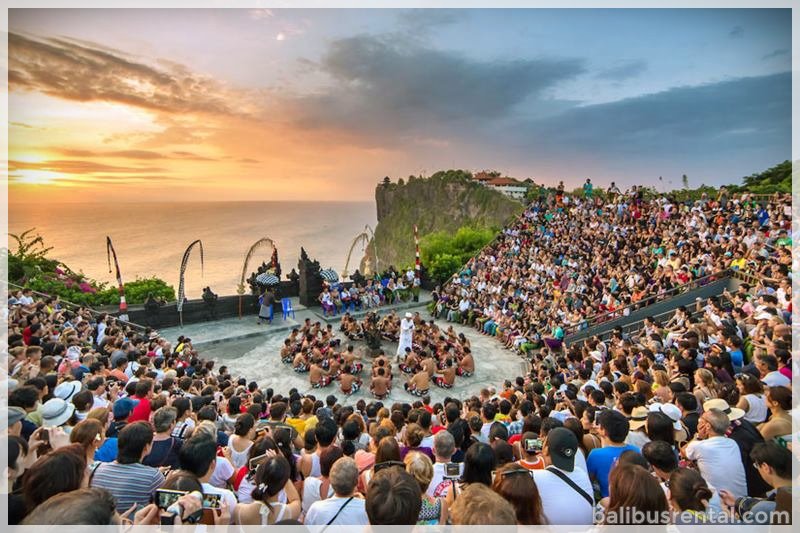
“Cak-cak-cak.” The obsessive sound of a choir from beyond the dust of ages suddenly rises between the lofty trees. Darkness looms over the stage.
Hundreds of bare-breasted men sit in a circle around the flickering light of an oil lamp chandelier. “Cak-Cak”. They start dancing to the rhythmic sound of their own voices, their hands raised to the sky and bodies shaking in unison. This is the unique Kecak, perhaps the most popular of all Balinese dances.
Visitors rarely leave the island of Bali without first seeing a Kecak performance. Originally the Kecak was just an element of the older Sang Hyang trance dance. It consisted of a male choir praying obsessively to the souls of their ancestors. At the initiative of painter Walter Spies, this religious choir was transformed into a dance by providing it with a narrative. The ballet is the Ramayana epic.
The prince Rama, his wife Sita and his brother Laksmana are exiled in the middle of the forest. Rama goes hunting a golden deer at the request of his wife, who saw the strange animal and has asked him to catch it. While he is away, she is kidnapped by Rahwana and taken to the latter’s island kingdom of Alengka (Srilangka).
Rama allies himself with the monkeys and in particular with the white monkey Hanuman. They build a bridge and cross to the island. War ensues until finally Rama defeats Rahwana and is again united with his faithful wife.
Barong and Kris Dance
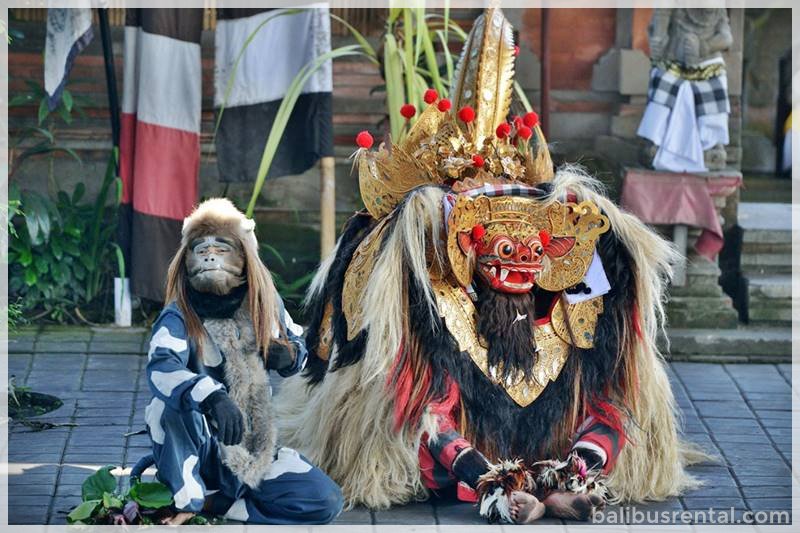
Barong and Kris dance like the Kecak dance the Barong and Kris dance is a battle between good and evil spirit. Barong can take various forms but in this dance he takes the form of the dance Barong Keket, the most holy of the Barongs. The Barong Keket is a strange creature, half shaggy dog, half lion and is played by two men in much the same way as a circus clown-horse. His opponent is the witch Rangda.
The barong personifies good and protects the village from the witch Rangda, but he’s also mischievous and fun loving creature. He flounces into the temple courtyard, snaps his jaws at the gamelan, dances around and enjoys the acclaim of his supporters-a group of men with krises.
The Rangda makes her appearance, her long tongue lolling, her pendulous breasts wobbling, human entrails draped around her neck, fangs protruding from her mouth and saber-like fingernails clawing the air.
Now Barong dance is no longer the clown, but the protector. The two duel with their magical powers and the Barong’s supporters draw their krises and rush in to attack the witch. Randa puts them in a trance and the men try to stab themselves, but the Barong also has great magical power and casts a spell which stops the krises from harming the men.
This the most dramatic part of the dance – as the gamelan rings crazily the men rush back and forth, waving their krises around, all but foaming at the mouth. Sometimes even rolling on the ground in a desperate attempt to stab themselves. Finally Rangda retires defeated and good has won again. Good must always triumph over evil on Bali, and no matter how many times the spectator have seen the performance nor how well they know the outcome, the battle itself remains all important.
The end of the dance still leaves a large group of entranced Barong supporters to be brought back to the real world. This is usually done by sprinkling them with holy water, sanctified by dipping the Barong’s beard in it. Performing the Barong and Randa dance – with all that powerful magic – is an operation not to be taken lightly.
Extensive ceremonies must be gone through to begin with, a temple priest must be on hand to end the dancers’ trance, and at the end a chicken has to be sacrificed to propitiate the evil spirits.
Legong Dance
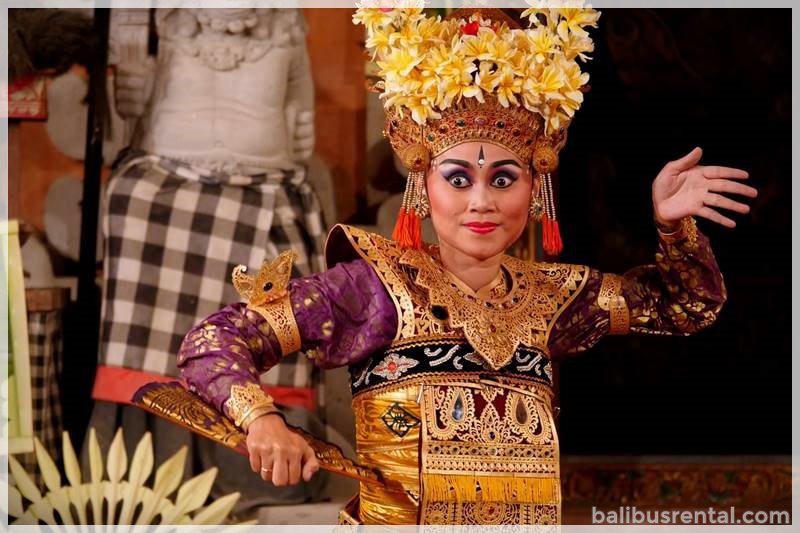
Legong this is the most graceful of Balinese dances and to sophisticated Balinese connoisseurs of dancing the one of most interest. A Legong Dance, as a Legong Dancer is always know, is a young girl – often as young as eight or nine years olds and older than her early teens. Such importance is attached to the dance that even in old age a classic dancer will be remembered as a ‘great Legong’ even though her brief period of fame may have been 50 years ago.
There are various forms of Legong but the Legong Kraton, or Legong of the palace, is the one most usually performed. Peliatan’s famous dance troupe, which visitor to Ubud often gets a chance to see, is particularly noted for its Legong. A performance involves just three dancers – the two Legongs and their ‘attendant’ knows as the condong. The Legongs are identically dressed in tightly bound gold brocade, so tightly are they encased that it’s something of a mystery how they manage to move with such agility and speed. Their faces are elaborately made up, their eyebrows plucked and repainted and their hair decorated with frangipanis.
It’s a very stylized and symbolic dance – if you didn’t know the story it would be impossible to tell what was going on. The dance relates how a king takes a maiden, Rangkesari, captive. When Rangkesari’s brother comes to release her he begs the king to let her free rather than go to war. The king refuses and on his way to the battle meets a bird bringing ill omens. He ignores the bird and continues on to meet Rangkesari’s brother who kills him. The dance however, only related the lead-up to the battle and ends with the bird’s appearance. When the king leaves the stage he is going to the battle that will end in his death.
The dance starts with the condong dancing an introduction. The condong departs as the Legong come on. The Legongs dance solo, in close identical formation, and even in mirror image when they dance a nose to nose love scene. They relate the king’s sad departure from his queen, Rangkesari’s request that he release her and the king’s departure for the battle. Finally the condong reappears with tiny golden wings as the bird of ill fortune and dance comes to an end.
Baris Dance
Baris the warrior dances know as the Baris is a male equivalent of the Legong in which feminist and grace gives way to the energetic, warlike, martial spirit. A solo dance, the Baris dancer has to convey the thoughts and emotions of a warrior preparing for action and them meeting an enemy in battle.
The dancer has to show his changing moods not only thought his dancing, but also through facial expression. Chivalry, pride, anger, prowess and finally some regret (well war is hell, even in Bali ) all have to be there. It’s said that the Baris is one of the most complex of the Balinese dances requiring a dancer of great energy, skill and ability.
Familiar tale in Bali but the dance has been a relatively recent addition to the Balinese repertoire. It tells much the same story of Rama and Sita as told in the Kecak Dance but without the monkey ensemble and with a normal gamelan orchestra accompaniment.
It’s also embellished with many improvisations and comic additions. Rawana may be played as a classic bad guy, the monkey god Hanuman can be a comic clown, and camera-wielding tourists amongst the spectators may come in for some imitative ribbing.
Kebyar Dance
Kebyar this is a male solo dance like the Baris Dance, but with greater emphasis on the performer’s individual abilities. Development of the modern kebyar is credited in large part to the famous pre war dance Mario.
There are various forms of the dance including the seated Kebyar Duduk where the ‘dance’ is done from the seated position and movements of the hands, arms and torso plus, of course, facial expressions are all important. In the Kebyar Trompong the dancer actually joins the gamelan and plays an instrument called the trompong while still dancing.
Janger Dance
Janger Both Covarrubias and Hickman in their between-the-wars books on Bali comment on this strange new, almost un-Balinese, dance which suddenly popped up in the 1920s and 1930s. Today it has become part of standard repertoire and no longer looks so unusual.
It has similarities to several other dances including the Sanghyang where the relaxed chanting of the women is contrasted with the violent cak-a-cak-a-cak of the men. In the Janger dance, formations of 12 girls and 12 young men do a sitting dance where the gentle swaying and chanting of the girls is contrasted with the violently choreographed movements and loud shouts of the men.
Topeng Dance
Topeng the word Topeng means ‘pressed against the face’, as with a mask. This is a mask dance where the dancers have to imitate the character their mask indicates they are playing. The Topeng Tua, for example, is a classic solo dance where the mask is that of an old man and requires the performer to dance like a creaky old gentleman.
In other dances there may be a small troupe who dances various characters and types. A full collection of Topeng masks may number 30 or 40.
Another mask dance is the Jauk dance, but this is strictly a solo performance. The dancer plays an evil demon, his mask an eerie face with bulging eyes and fixed smile, long wavering fingernails complete the demonic look.
Mask dances require great expertise because the dancer is not able to convey the character’s thoughts and meanings though his facial expressions, so the character of the unpleasant, frenetic, fast-moving demon has to be conveyed entirely through the dance.
Pendet Dance
Pendet this is an everyday dance of the temples, a small procedure gone through before making temple offerings which doesn’t require arduous training and practice. You may often see the Pendet dance being danced by women bringing offerings to a temple for festival, but it is also sometimes danced as an introduction and a closing for other dance performances.
Sanghyang Dance
Sanghyang Dances the Sanghyang trance dancea originally developed as a means of driving out evil spirits from a village. The Sanghyang is a divine spirit which temporarily inhabits an entranced dancer.
The Sanghyang Dedari is performed by two young girls who dance a dream-like version of the Legong. The dancers are said to be untrained in the intricate pattern of the dance and, furthermore, the dance in perfect harmony but with their eyes firmly shut.
A female choir and a male Kecak choir provide a background chant but when the chant stops the dancers’ slump to the ground in a faint. Two women bring them round and at the finish a priest blesses them with holy water and brings them out of the trance. The modern Kecak dance developed from the Sanghyang.
In the Sanghyang Jaran a boy in a trance dances round and through a fire of coconut husks riding a coconut-palm hobby horse-it’s labeled the fire dance’ for the benefit of tourist. Once again the priest must be on hand to break the trance at the close of the dance.
The Gamelan: Traditional Balinese Music and Its Cultural Significance
Gamelan is the heart of traditional Balinese music and one of the most distinctive elements of Bali’s rich cultural heritage. Similar to the musical traditions of Java and Sumatra, Balinese music is largely based on the gamelan orchestra, an ensemble of traditional instruments that produces a unique combination of rhythmic patterns, metallic melodies, resonant gongs, and energetic percussion. The sound of gamelan is closely connected to Balinese Hindu ceremonies, temple festivals, traditional dances, religious rituals, and community celebrations.
In Bali, a gamelan ensemble is sometimes referred to by the name of its principal instrument, the gong. Two well-known types of gamelan are Gong Gede and Gong Kebyar, each with its own musical character, history, and performance style. Gong Gede is an older and more ceremonial form of gamelan, traditionally associated with important religious occasions and temple ceremonies. Its music is generally stately, majestic, and measured, creating an atmosphere of solemnity and spiritual devotion.
In contrast, Gong Kebyar is a more modern and dynamic style of Balinese gamelan that became prominent in the early twentieth century. The word kebyar is commonly associated with the idea of bursting open or suddenly bursting into brilliance, which reflects the ensemble’s dramatic changes in tempo, volume, and musical intensity. Gong Kebyar performances are known for their powerful rhythms, rapid melodies, sudden pauses, and exciting musical exchanges between instruments. This energetic style is particularly popular as an accompaniment to traditional Balinese dance and cultural performances.
Ancient Gamelan Traditions in Bali
Beyond the better-known Gong Gede and Gong Kebyar ensembles, Bali also preserves ancient forms of traditional gamelan that reflect the island’s long musical history. One notable example is Gong Selunding, an unusual ensemble associated with Bali Aga communities, particularly the traditional village of Tenganan Pegringsingan in eastern Bali.
Bali Aga villages are known for preserving distinctive customs, traditional village structures, ceremonies, and cultural practices that differ in certain respects from those of other Balinese communities. Gong Selunding is especially significant because of its association with local ritual traditions and its distinctive metallophone instruments. Its sound and performance style offer a fascinating glimpse into older layers of Balinese musical heritage.
For visitors interested in traditional Balinese culture, discovering these ancient musical traditions provides a deeper understanding of the island beyond its famous beaches, rice terraces, and tourist attractions. The preservation of traditional gamelan ensembles demonstrates how music continues to connect Balinese communities with their ancestors, religious beliefs, and cultural identity.
Balinese Gamelan Instruments and Musical Style
Although many gamelan traditions across Indonesia use similar types of instruments, including bronze or iron metallophones, gongs, drums, and other percussion instruments, the musical styles can differ considerably from one region to another.
A traditional Balinese gamelan orchestra may include metallophones that play interlocking melodies, large hanging gongs that mark important points in the musical structure, and kendang drums that help control the tempo and coordinate the ensemble. Smaller gongs and cymbals contribute additional rhythmic patterns, while the musicians work together to create a complex and lively musical texture.
One of the most distinctive characteristics of Balinese gamelan is its interlocking rhythmic technique, often called kotekan. In this technique, two groups of musicians play complementary parts of a melody, producing rapid and intricate musical patterns that may sound almost impossibly fast to an unfamiliar listener. Rather than one musician playing the entire melody, the notes are divided between players, creating a brilliant and flowing sound.
Balinese gamelan is also famous for its dramatic changes in tempo and volume. The music can shift from quiet, delicate passages to powerful bursts of sound within moments. These changes create excitement, tension, and emotional expression, especially when the orchestra accompanies a traditional dance performance.
The combination of rhythmic precision, teamwork, and musical complexity makes a gamelan orchestra an impressive example of collective artistic expression. Each musician has a specific role, and the performance depends on the close coordination of the entire ensemble.
The Difference Between Balinese and Javanese Gamelan
Although Balinese and Javanese gamelan share some instruments and broader musical traditions, they often have noticeably different sounds and performance styles.
Traditional gamelan from Yogyakarta in Central Java, for example, is widely associated with a refined, restrained, and carefully balanced musical style. In certain court traditions, the music emphasizes subtlety, measured pacing, and graceful melodic development. Its atmosphere can be calm, meditative, and formal, making it suitable for palace ceremonies, classical dance, and other traditional performances.
Balinese gamelan, particularly Gong Kebyar, is often more energetic, dramatic, and rhythmically intense. Its rapid interlocking melodies, powerful percussion, sudden changes, and sharp accents create an exciting sound that can immediately capture the listener’s attention. The music often complements the expressive gestures, eye movements, and dynamic movements of Balinese dance.
These differences should not be understood as absolute rules. Both Bali and Java have diverse musical traditions, and some ensembles in each region have styles that differ significantly from these general descriptions. Nevertheless, the contrast between the restrained atmosphere of certain Javanese court gamelan traditions and the explosive energy of Gong Kebyar is one of the most recognizable features of Indonesian traditional music.
Gamelan in Everyday Balinese Life
One of the most remarkable things about traditional Balinese music is how closely it is woven into everyday community life. In Bali, gamelan is not simply music performed on a stage for an audience. It is an important part of religious ceremonies, temple anniversaries known as odalan, traditional dances, cremation ceremonies, village festivals, and other significant social occasions.
Visitors travelling around Bali may hear gamelan music coming from village temples, community halls, cultural centers, and traditional performance spaces. Musicians frequently gather to rehearse for upcoming ceremonies or performances, while younger generations learn the instruments and musical techniques from experienced players.
Many villages maintain their own gamelan ensembles, which are often connected to local community organizations and traditional customs. Preparing for a ceremony or performance can involve considerable cooperation among musicians, dancers, families, and other community members. In this way, gamelan strengthens social relationships and helps preserve Balinese cultural traditions.
Gamelan music also accompanies many famous Balinese dance performances, including the Barong dance, Legong dance, and various forms of ceremonial dance. The musicians and dancers work closely together, responding to changes in rhythm, tempo, and musical emphasis. The orchestra does more than provide background music; it helps shape the movements, mood, and dramatic development of the performance.
Experiencing Traditional Gamelan Music in Bali
For tourists exploring Bali, listening to a live gamelan orchestra is an excellent way to experience the island’s traditional arts and cultural heritage. Cultural performances in places such as Ubud and other established tourist destinations often feature gamelan music alongside traditional Balinese dance. Visitors may also encounter rehearsals or ceremonial performances in local villages, depending on the timing of their visit and the customs of the community.
A live performance allows visitors to appreciate details that recordings may not fully capture: the resonance of the gongs, the precision of the interlocking melodies, the powerful rhythm of the drums, and the coordinated movements of the musicians. Watching the orchestra accompany traditional dancers also reveals how closely Balinese music, dance, and religious traditions are connected.
Visitors should remember that gamelan performances can take place in both cultural entertainment settings and sacred religious contexts. When attending a temple ceremony or village ritual, it is important to respect local customs, follow guidance from the community, and ask permission before photographing people or sacred activities.
Whether heard during a colorful cultural show, a traditional village celebration, or a religious ceremony, gamelan offers a memorable introduction to the artistic spirit of Bali. Its combination of ancient traditions, intricate rhythms, and vibrant musical energy continues to make it an essential part of the island’s identity.
Discover the beauty of Balinese culture through traditional gamelan music, and experience how this remarkable orchestra brings together music, dance, spirituality, and community life throughout the Island of the Gods.